
India’s Emerging Merchant BESS Market Faces Its First Regulatory Test
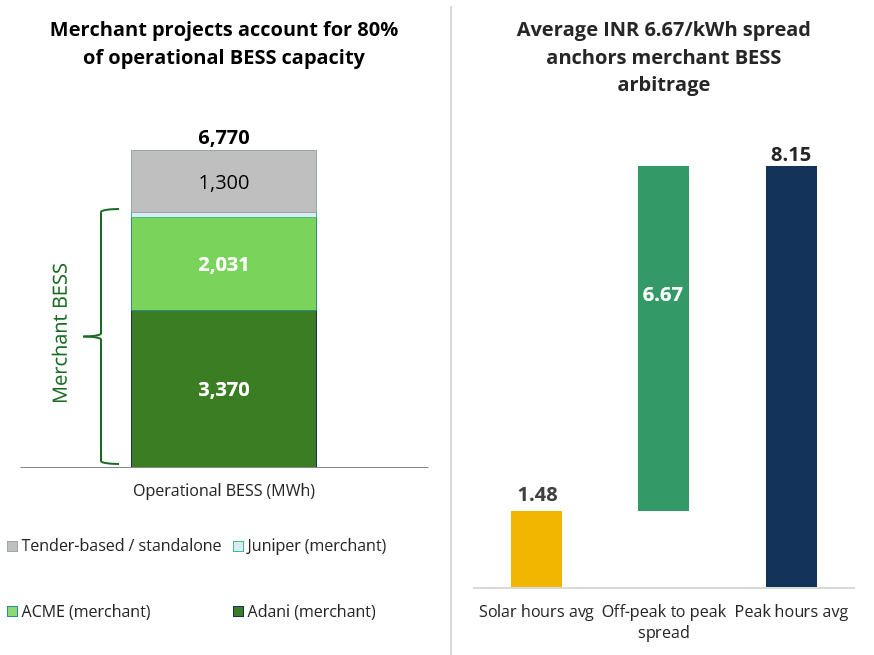
India’s battery energy storage system (BESS) sector has reached an inflection point. Deployment is now scaling at pace, and the merchant model has emerged as the favoured route to market, accounting for 80% of roughly 6.8 GWh of operational BESS capacity. Recent additions have been led by large merchant projects, including Adani’s 3,370 MWh project in Gujarat and ACME’s 2,031 MWh project in Rajasthan. The shift was driven by a sharp decline in BESS costs and a parallel rise in market revenue potential.
A merchant battery operates without a long-term contract, charging when exchange prices are low and discharging when prices are high. This is both commercially relevant and system-relevant in India’s power market, where surplus mid-day solar generation increasingly coincides with lower prices, while demand and prices rise toward the evening peak. This was visible in April 2026, when surplus solar drove Real-Time Market prices on the Indian Energy Exchange (IEX) to near-zero levels, even as evening Day-Ahead Market (DAM) prices approached the INR 10/kWh cap. For merchant batteries, this spread creates a direct revenue opportunity while also helping shift clean power to peak-demand hours and reduce renewable curtailment.
Figure 1: India’s grid-scale operational BESS capacity by procurement model (in MWh); Average peak and off-peak DAM prices on IEX, May 2026 (INR/kWh)
Source: IEX, JMK Research
Two new draft grid-security measures now risk weakening the arbitrage logic that underpins the merchant BESS model:
- At the central level, the 44th Consultation Meeting for Evolving Transmission Schemes in Western Region (CMETS-WR) agenda requires storage projects seeking ISTS connectivity to maintain a minimum two-hour duration and to install commensurate renewable capacity, solar or wind, exclusively for charging. CTUIL bars any withdrawal of power from the ISTS grid at any time, reasoning that to utilise injection rights during non-solar hours, a battery must be charged by its own commensurate renewable generation. Developers are explicitly forbidden from using their granted solar-hour capacity to charge the battery, as that capacity is reserved solely for direct grid injection.
- At the state level, Rajasthan’s RVPN draft procedure of May 2026, applicable to battery storage co-located with renewable generation, prohibits grid charging outright and confines the battery charging solely to its own renewable generation, fixing it to solar hour (10:00 to 15:00) for evening discharge, and night-time wind hour (00:00 to 04:00) for morning discharge. The utility reasons that battery operation cannot be aligned purely with market prices, as scheduling must address system constraints, congestion, and grid discipline. It therefore vests the SLDC with authority to curtail or reschedule operations and stipulates that storage must run on a system-driven, not market-driven framework.
A captive renewable mandate turns a battery-only project into a hybrid build, lifting project capex by at least 60-80%, depending on RE configuration. Additionally, setting up a solar or wind project involves additional land, construction, connectivity and regulatory approvals, further lengthening the development cycle. The revenue side is hit simultaneously, as restricting charging to solar or wind generation windows limits access to the cheapest grid-price hour and compresses arbitrage spreads. Further, SLDC discretion over curtailment adds dispatch uncertainty, which lender are likely to price into higher debt costs. Together, higher capex, lower spreads and reduced operational flexibility erode the economics of the merchant BESS model that has driven recent market interest in the BESS market.
India has crossed the 50% non-fossil installed power capacity mark in 2025, ahead of its 2030 target, and the National Electricity Plan (NEP, 2023) estimates a BESS requirement of 47.24 GW/236.22 GWh by 2031─32. A target of this scale and timeline will require procurement routes that are bankable, scalable and responsive to system conditions. Thereby, a blanket prohibition on an emerging and bankable BESS model is disproportionate to the RE intermittency risks it seeks to manage. These provisions have drawn sharp pushback from developers and industry stakeholders, who flag material risks to project economics and feasibility.
Rather than a blanket prohibition, more targeted measures such as permitting grid charging in pre-defined off-peak or surplus-solar windows, tying withdrawal rights to available transmission margins, and limiting SLDC intervention to transparent, pre-specified congestion or grid-security events, will be essential in addressing the sudden disruption of merchant BESS economics. The recently concluded 45th CMETS-WR meeting has moved partially in this direction, but its timely and consistent implementation across central and state regulators is essential. As India ventures to bridge the gap between RE generation, transmission and consumption through energy storage mechanisms, policy induced uncertainties can tighten financing, slow BESS deployment, and ultimately constrain the firm capacity needed to support India’s renewable energy build-out.