
Can Delhi’s New EV Policy Deliver 95% EV Registrations by 2027?
Delhi has been one of India’s leading electric vehicle (EV) markets over the past few years. Building on the success of its 2020 EV policy, the city has now rolled out the Delhi EV Policy 2026, effective from July 1, 2026, to March 31, 2030. Backed by an estimated INR 15,000 crore in incentives and tax exemptions, the policy is among the most ambitious state-level EV initiatives in India. Before examining the policy provisions, it is useful to understand how Delhi’s EV market has evolved and why the government believes a stronger policy intervention is now required.
Delhi’s EV market scenario since 2020
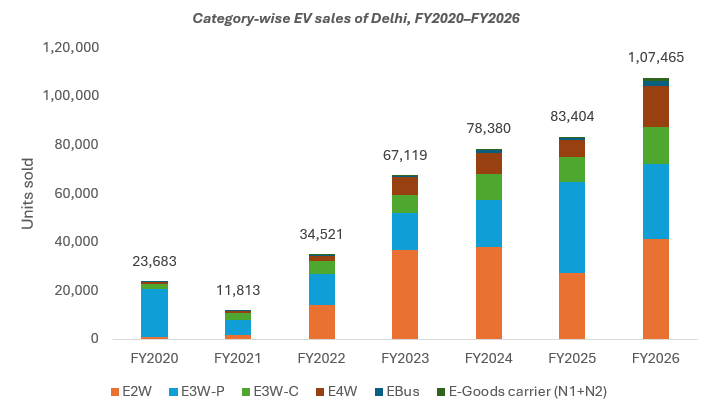
Delhi’s EV sales have grown by 4.5 times over the last six years, from 23,683 units in FY2020 to over 1,07,465 units in FY2026. While overall adoption has accelerated, growth has varied across vehicle segments, reflecting differences in technology maturity, use cases and market acceptance.
Figure 1: Category-wise EV sales of Delhi, FY2020–FY2026
Source: JMK Research, Vahan Dashboard, Telangana RTO.
Note: N1= Small trucks weighing up to 3.5 tonnes, N2= Medium trucks weighing between 3.5 tonnes and 12 tonnes
- Three-wheelers (E3W-P and E3W-C) continue to anchor Delhi’s EV market, with passenger and cargo e3Ws together accounting for over 46,000 registrations (around 43% of total EV sales) in FY2026.
- Electric two-wheelers (E2W) have witnessed the fastest growth, rising from 963 units in FY2020 to over 41,119 units in FY2026, making them the largest individual EV segment with 38% market share in FY2026.
- Electric four-wheelers (E4W) and E-buses, by comparison, remain small in volume under 17,000 and under 2,000 units respectively in FY2026, even though both have grown steadily year on year.
- Electric goods carriers (E-Goods carrier) both N1 and N2, are emerging as a promising segment. Although volumes remain modest, registrations have grown steadily from FY2022, reflecting increasing electrification of last-mile logistics and urban freight.
Why Delhi needed a stronger EV policy?
Delhi’s growing EV market reflects a broader effort to address one of the city’s biggest environmental challenges i.e. vehicular pollution. According to the Commission for Air Quality Management (CAQM),
- Direct vehicular emissions account for around 23% of Delhi’s winter PM2.5 pollution.
- Secondary particulate matter linked to vehicular and other precursor emissions contributes about 27% in winter and 17% in summer, making transport one of the largest contributors to Delhi’s air pollution across seasons.
To address this, EV Policy 2026 marks a clear shift from the city’s 2020 policy. While the earlier policy primarily relied on purchase incentives and tax exemptions to encourage EV adoption, the new policy complements these measures with phased registration restrictions on fossil-fuel vehicles, signalling a transition from an incentive-led approach to a more regulation-driven strategy.
Why the mandates target Two-wheelers and Three-wheelers?
The policy’s most significant regulatory measures are the phased registration deadlines for two- and three-wheelers. From January 1, 2027, only electric autorickshaws can be newly registered, while new petrol and CNG two-wheelers will no longer be registered from April 1, 2028. These timelines reflect the different stages of electrification across the two segments. Three factors explain why these vehicle categories have been prioritised:
- Highest pollution contribution: Two- and three-wheelers together account for around 46% of Delhi’s vehicular pollution, compared with about 33% from goods vehicles, making them the largest source of transport emissions.
- Largest share of the EV market: E2W and E3W together contributed over 80% of Delhi’s EV registrations in FY2026, indicating that electrification in the city has largely been driven by these segments.
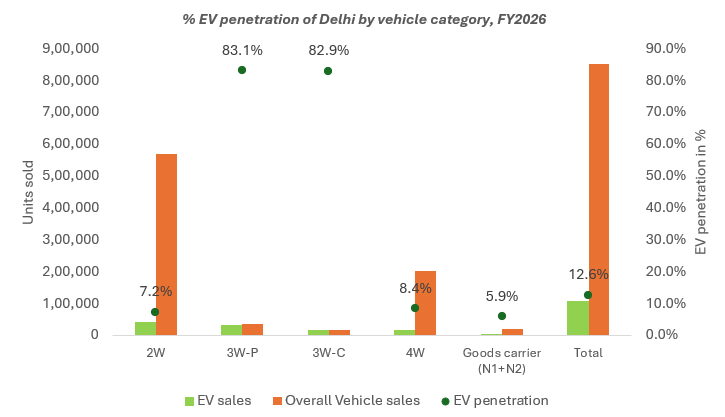
- Different levels of market maturity: E3Ws have already achieved over 83% penetration of new three-wheeler sales, meaning the transition is largely complete. In contrast, E2Ws account for only 7.2% of total two-wheeler sales, despite strong growth in absolute volumes, highlighting substantial room for further adoption.
Figure 2: EV penetration (in %) of Delhi by vehicle category, FY2026
Source: JMK Research, Vahan Dashboard, Telangana RTO.
Charging infrastructure is also unlikely to be a major constraint for these segments. An estimated 85–90% of charging for two- and three-wheelers already takes place through private or captive infrastructure, such as homes, residential societies and fleet depots, where overnight charging is sufficient due to their smaller battery sizes. While Delhi currently has over 10,000 charging points against an estimated requirement of 36,000, the policy’s target of adding 30,000 public charging points will further strengthen the ecosystem, particularly for passenger cars and commercial fleets. For two- and three-wheelers, affordability and consumer adoption are likely to remain more important challenges than charging availability.
Accelerating EV Adoption Through Financial Incentives
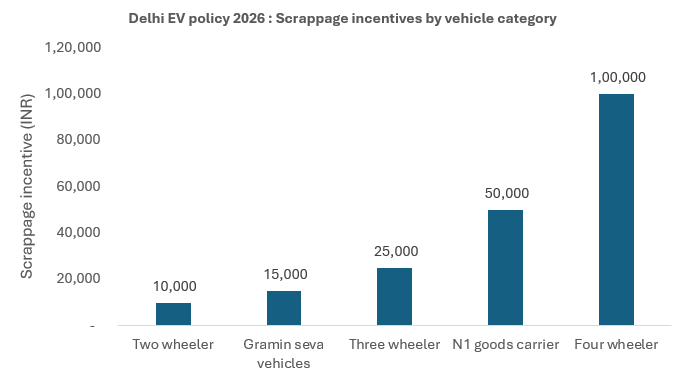
Another notable feature of Delhi EV Policy 2026 is its focus on accelerating the replacement of older ICE vehicles. Instead of only incentivising new EV purchases, the policy links scrappage incentives with purchase subsidies, making it financially more attractive for owners of older vehicles to switch to electric. (see Figure 3).
Figure 3: Delhi EV policy 2026- Scrappage incentives by vehicle category
Source: JMK Research, Delhi EV policy 2026
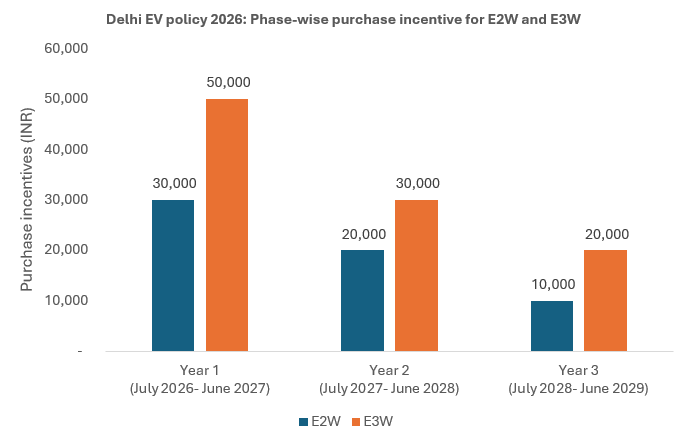
Owners scrapping eligible Delhi-registered BS-IV and older vehicles receive an additional scrappage incentive over and above the purchase subsidy, making early replacement financially more attractive. To prevent misuse, vehicles purchased under the scheme are subject to a three-year lock-in period, during which they cannot be sold or re-registered outside Delhi. The policy adopts a declining incentive structure, with purchase subsidies reducing over successive years (see Figure 4). Combined with the 100% road tax and registration fee waiver (capped at INR30 lakh ex-showroom for E4W), this creates a clear signal that the financial benefits are highest during the initial years of the policy, encouraging early adoption rather than delaying purchase decisions.
Figure 4: Delhi EV policy 2026- Phase-wise purchase incentive for E2W and E3W
Source: JMK Research, Delhi EV policy 2026
What Happens to Trucks and Commercial Goods Vehicles
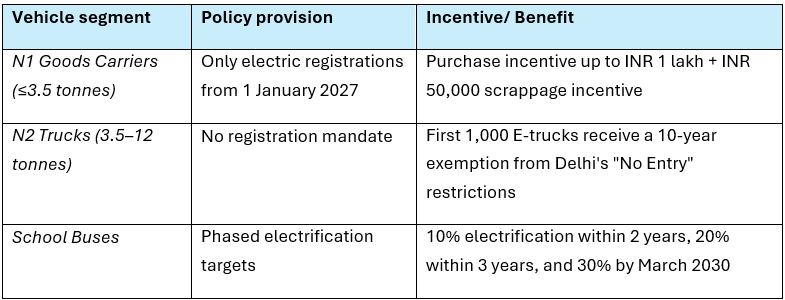
Unlike two- and three-wheelers, the electrification of commercial goods vehicles is still at a relatively early stage. In FY2026, electric goods carriers (N1 and N2) accounted for only 1,248 registrations out of 21,240 total goods carrier sales, resulting in an EV penetration of less than 6% (see Figure 2). Since N1 trucks constitute nearly 80% of Delhi’s commercial goods vehicle fleet, the policy primarily focuses on this segment while introducing targeted measures for N2 trucks and school buses.
Table 1: Key policy measures for commercial vehicles under Delhi EV Policy 2026
Source: JMK Research, Delhi EV policy 2026
Can Delhi Achieve Its EV Ambitions?
Delhi EV Policy 2026 marks a shift from an incentive-led approach to a more regulation-driven strategy for accelerating electric mobility. By limiting fiscal incentives to battery electric vehicles (BEVs) and excluding hybrids, the policy signals a clear focus on achieving zero tailpipe emissions.
The scale of the ambition is evident from its targets. Delhi’s EV penetration stood at 12.6% of new vehicle sales in FY2026 (see Figure 2), while the policy aims to increase the share of EVs in the overall vehicle fleet to around 30% by 2030, alongside a target of 95% of all new vehicle registrations being electric by 2027. Achieving these milestones within the next four years will require not only sustained consumer adoption but also effective implementation of registration mandates, charging infrastructure expansion and supporting ecosystem development. If successful, Delhi could provide a practical blueprint for other Indian cities/ states seeking to reduce transport emissions through a combination of targeted incentives and regulatory mandates.