India Sets Emission Reduction Targets for Its Iron & Steel Entities
The Central Government is adding the Iron & Steel sector to the Greenhouse Gases Emission Intensity Target Rules and setting time-bound emission reduction targets for 255 Iron & Steel manufacturing facilities across India. With this addition, the emission reduction rules now cover nine industrial sectors in India: Cement, Chlor-alkali, Iron & Steel, Aluminium, Textile, Petrochemicals, and others.
Table: Salient features of Draft Greenhouse Gases Emission Intensity Target (Amendment) Rules, 2025
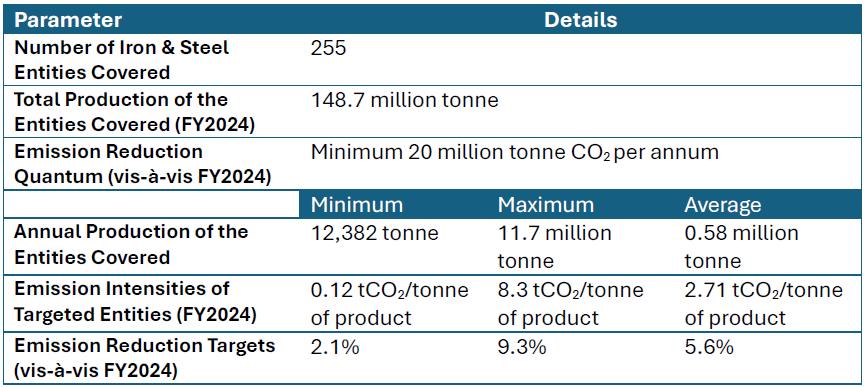
Source: Ministry Of Environment Forest and Climate Change
The 148.7 million tonnes of cumulative production covered under the rules spans the entire spectrum of the Iron & Steel ecosystem in India, ranging from large Blast Furnace – Basic Oxygen Furnace (BF-BOF) and Direct Reduced Iron (DRI) manufacturers to smaller induction furnace entities with or without rolling mills. The top 10 facilities (by annual production) covered under the rules are all large scale BF-BOF steel producers, jointly representing approximately half of the entire production targeted.
The rules establish a clear and standard emission reduction trajectory for the entire Indian Iron & Steel sector. The emission reduction targets set for FY2027 vary from 2.1% to 9.3% across the entities covered, with the entity’s type, current emission intensity and location being the significant influencing factors of its associated target. Overall, the emission intensity target rules aim to reduce the total annual emissions of the Iron & Steel sector in India by at least 20 million tonne CO2 by FY2027.
The emission reduction targets also align with India’s own carbon market pricing framework under the Carbon Credit Trading Scheme (CCTS). Entities that perform better than their targets earn tradeable Carbon Credit Certificates (CCCs), while those that fall short must purchase certificates to cover the shortfall.
The entire world is moving towards meticulous carbon tracking and pricing frameworks such as the European Union’s Carbon Border Adjustment Mechanism (CBAM). Thereby, inclusion of one of India’s largest emitting and energy consuming sectors in its emission reduction target rules not only enables emission abatement but also brings Indian steel MSMEs under the ambit of carbon measurement and tracking ecosystem.
While the emission reduction targets are currently minimal (an average of 5.6%) and can be largely met with renewable energy and energy efficiency measures, the manufacturers must plan for subsequent updates of the rules with increasingly stringent emission reduction targets. Hence, the next stage will be to translate this policy into creating an enabling environment for the manufacturers to participate collaboratively in achieving these targets. Overall, the synergy of emission intensity reduction rules and CCTS will define India’s carbon market growth trajectory, which will ultimately shape India’s decarbonization journey to Net-Zero by 2070.