
Beyond Battery Packs: Localisation in manufacturing EV components
Date of release: June 2026
Report by JMK Research and IEEFA
India’s electric vehicle (EV) market has grown nearly 14-fold since financial year (FY) 2020 in areas including electric two-wheelers (E2Ws), electric three-wheelers (E3Ws), buses, and passenger vehicles. This rapid growth is transforming the value chain in India’s automotive sector, with value shifting from traditional metal-based components to sophisticated electronic systems and advanced assemblies. While this presents substantial opportunities for the sector, it also introduces significant challenges that require strategic adaptation.
Localisation levels have also improved across EV segments, with many original equipment manufacturers (OEMs) now undertaking domestic assembly and local sourcing for structural and mechanical components. However, a deeper assessment of the supply chain reveals that localisation remains uneven at the component level, particularly for systems unique to EVs such as motors, battery packs, power electronics, and charging systems.
Recent policy measures and industrial investments indicate growing domestic capability in key EV components. Sustaining this momentum requires a stronger focus on indigenous research and development (R&D) into critical raw materials. The next phase of growth will be defined by India’s ability to secure the upstream ecosystem for the core technologies that power modern EVs.
Current localisation levels and 2030 potential
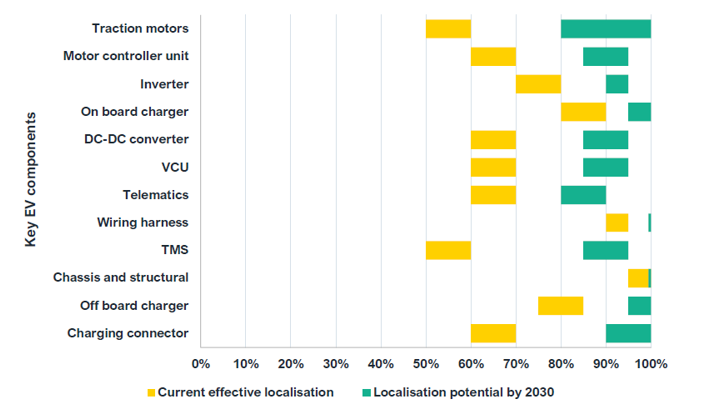
Source: Industry stakeholders, news articles, company webpages, JMK Research
Localisation outcomes vary significantly across EV components, with categories aligned to India’s established automotive manufacturing strengths such as chassis systems, structural parts, wiring harnesses, and thermal systems achieving high levels of domestic manufacturing. In contrast, components dependent on advanced electronics, specialised materials, and high-precision processes continue to record low localisation levels due to reliance on imported subcomponents, limiting India’s share of component value despite increasing local manufacturing activity.
Several structural constraints continue to limit deeper localisation. Global supply chains for automotive chips, rare-earth magnets, and critical materials remain heavily concentrated in a few countries, creating risks related to supply security, pricing, and geopolitical disruptions. Domestic suppliers continue to face challenges around cost competitiveness, technology ownership, and achieving domestic value addition (DVA) requirements under existing incentive schemes.
Going forward, advancement in localisation will require a transition from assembly-led manufacturing to stronger domestic capability in component design, advanced materials, and electronics. Achieving this will depend on broadening supplier participation, strengthening domestic R&D, improving manufacturing competitiveness, and accelerating development of critical materials. Translating India’s large EV market into globally competitive manufacturing capability across the component value chain will ultimately determine the sector’s long-term trajectory.
Table of Contents
- Key findings
- Executive summary
- Introduction
- India’s EV components ecosystem
- Current state of play
- Policy Landscape
- Developments in component manufacturing
- Risks and challenges
- Way forward
- Conclusion
Enter Email to Download the full Report: