
Driving Into Double Digits: India’s EV Penetration Reaches 12% in H1 FY2027
Market overview
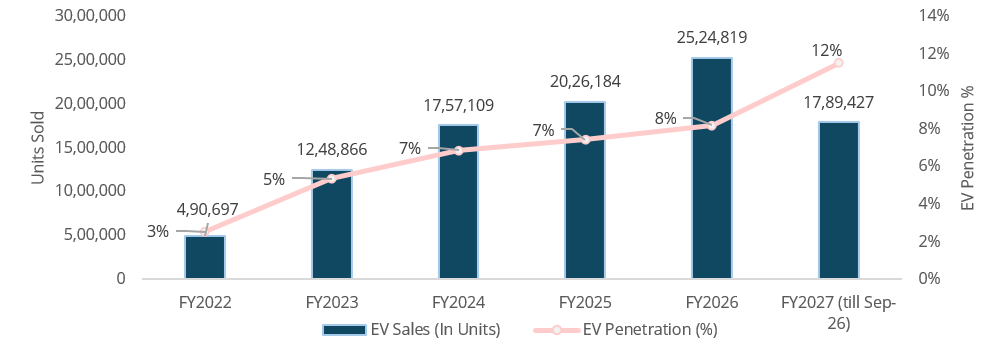
India recorded 17.89 lakh EV sales in H1 FY2027 (April–September 2026), a 59.3% increase over H1 FY2026. In just six months, sales reached nearly 71% of FY2026’s annual total of 25.25 lakh units. Overall EV penetration rose to 12% from 8% in FY2026, marking a 4-percentage-point gain, the strongest increase across the periods covered since FY2022.
Figure 1: EV Sales and Penetration in India, FY2022–H1 FY2027
Source: JMK Research, Vahan Dashboard
Annual EV sales increased more than fivefold between FY2022 and FY2026. In H1 FY2027, electric vehicles accounted for approximately one in eight new vehicle registrations. Wider model choice, lower running costs, and demand from commercial fleets are key drivers of adoption, although growth rates vary across vehicle segments.
Market overview Segment-wise EV Sales and Penetration
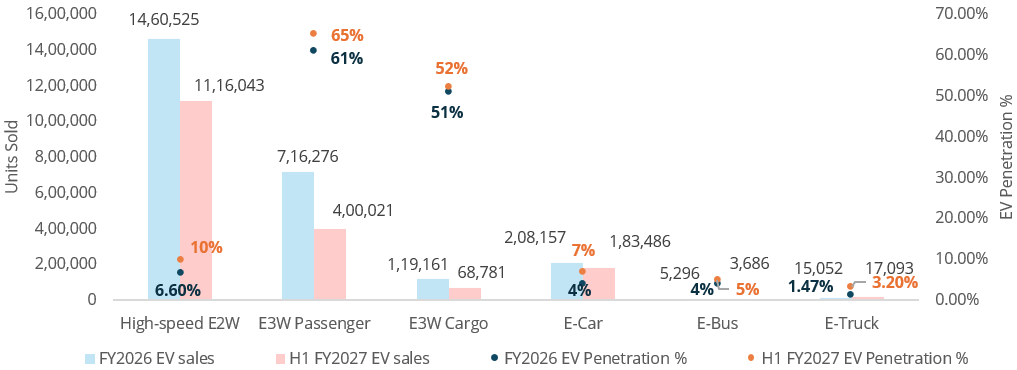
Figure 2: Segment-wise EV Sales and Penetration in India-FY2026 vs H1 FY2027
Source: JMK Research, Vahan Dashboard
- E2W: High-speed E2W sales reached 11.16 lakh units in H1 FY2027, equivalent to 76.4% of FY2026’s annual sales, remaining the largest contributor to EV volumes. EV penetration rose significantly in just 6 months, reaching 10% in H1 FY2027 compared with 6.6% in FY2026, supported by more affordable models and demand from B2B delivery fleets. OEMs are also moving from NMC-only offerings towards a mix of NMC and LFP batteries, expanding consumer choice across price and performance levels.
- E3W (Passenger & Cargo): Passenger and cargo E3W sales reached 4.00 lakh and 0.69 lakh units in H1 FY2027, respectively, equivalent to 55.8% and 57.7% of FY2026’s annual sales. Passenger EV penetration rose from 61% to 65%, while cargo penetration saw a marginal increase. [MS1] Demand is supported by last-mile passenger connectivity and intra-city goods movement, where frequent daily trips make lower operating costs particularly attractive to operators.
E-car: E-car sales reached 1.83 lakh units in H1 FY2027, equivalent to 88.1% of FY2026’s annual sales, while penetration increased from 4% to 7%. During the period, 12 models were launched by OEMs including Tata Motors, MG Motor, Kia, Mahindra and BMW, expanding choice across price segments. These included one plug-in hybrid electric vehicle (PHEV), while seven of the 12 models offer Battery-as-a-Service (BaaS) options, improving affordability through lower upfront costs and separate battery payments.
E-Bus: Sales reached 3,686 units in H1 FY2027, equivalent to 69.6% of FY2026’s annual sales, while penetration rose marginally. Government procurement supports growth, with around 24,000 e-buses planned under PM E-DRIVE and PM-eBus Sewa. Supporting this rollout, the Payment Security Mechanism (PSM) covered 27,555 buses as of July 10, 2026, including 14,000 under PM E-DRIVE, 10,000 under PM-eBus Sewa and 3,555 under state initiatives, protecting operators against payment defaults.
E-Trucks: Sales reached 17,093 units in H1 FY2027, exceeding FY2026’s annual total by 13.6%, while penetration rose from 1.47% to 3.20%. Light goods vehicles (LGVs) accounted for around 92% of sales, supported by e-commerce deliveries and corporate efforts to electrify last-mile fleets. Heavy goods Vehicles (HGVs) increased their share from 6% to 8%, with adoption in project-based applications such as cement transportation, mining and port logistics, while medium goods vehicles (MGVs) remained marginal.
With overall EV penetration already at 12% in H1 FY2027, expanding product portfolios, improving charging access, wider BaaS availability and measures to improve electric truck utilisation are expected to sustain growth across India’s EV market. Supported by these developments, overall EV penetration is projected to reach 14–15% by the end of FY2027.