
India’s EV Market Grows 43% YoY in H1 2026
Market overview
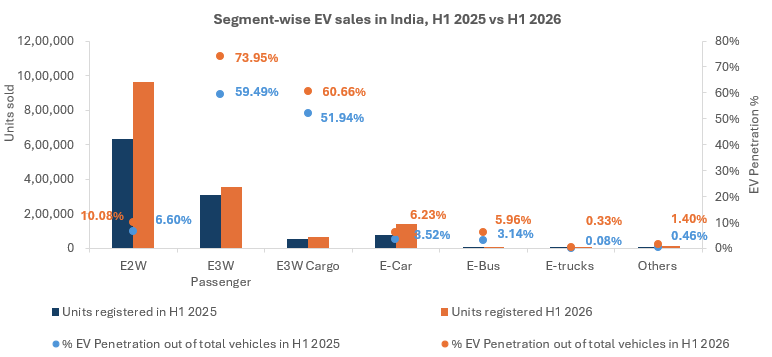
The overall EV market in India recorded 15,41,377 units in H1 2026 (Jan 2026- Jun 2026), a 43% increase year-on-year (YoY), with EV penetration rising to 11.43% from 8% in H1 2025 (Jan 2025- Jun 2025). Segment-level trends reveal how electrification is progressing across different vehicle categories.
Figure 1: Segment-wise EV sales in India, H12025 Vs. H12026
Source: JMK Research, Vahan Dashboard
E2W: The E2W segment remained the largest EV segment, with its market share increasing from 58.51% in H1 2025 to 62.53% in H1 2026. This growth was primarily driven by aggressive promotional offers and discounts ahead of the March 2026 PM E-Drive scheme deadline for E2Ws (later extended to July 31, 2026), rising fuel prices that further strengthened the total cost of ownership advantage of electric two-wheelers, and robust demand from fleet operators and the quick-commerce sector.
E3W (Passenger & Cargo): The E3W segment maintained strong momentum in H1 2026, with EV penetration rising to 73.95% in the passenger segment and 60.66% in the cargo segment, up from 59.49% and 51.94% respectively in H1 2025. Notably, the segment continued to grow despite the withdrawal of PM E-DRIVE incentives and cargo E3Ws after December 2025, indicating that demand is becoming increasingly driven by market demand rather than government subsidies.
E-Car: The E-car segment recorded an 83% YoY increase in cumulative sales during H1 2026, driven by an expanding product portfolio, with eight new models launched in H1 2026, including Maruti Suzuki E-Vitara, Tata Harrier EV and Mahindra XUV 3XO EV, thereby expanding consumer choice across multiple price segments.
E-Bus: The E-bus segment recorded a 42% YoY increase in cumulative sales during H1 2026, rising from 2,130 units to 3,021 units. Growth was supported by the ongoing rollout of the PM E-Bus Sewa and PM E-DRIVE schemes, with the award of large-scale E-bus tenders, increasing fleet deployments by state transport undertakings (STUs), and continued procurement by public transport authorities across multiple states.
E-Trucks: The E-truck segment recorded a 339.57% YoY increase in cumulative sales during H1 2026, rising from 139 units to 611 units. The growth was driven by the expanding availability of electric truck models, increasing adoption by logistics, e-commerce, and industrial fleets to meet their decarbonization and ESG goals, and improved total cost of ownership for high-utilization commercial operations.
Player-wise Performance
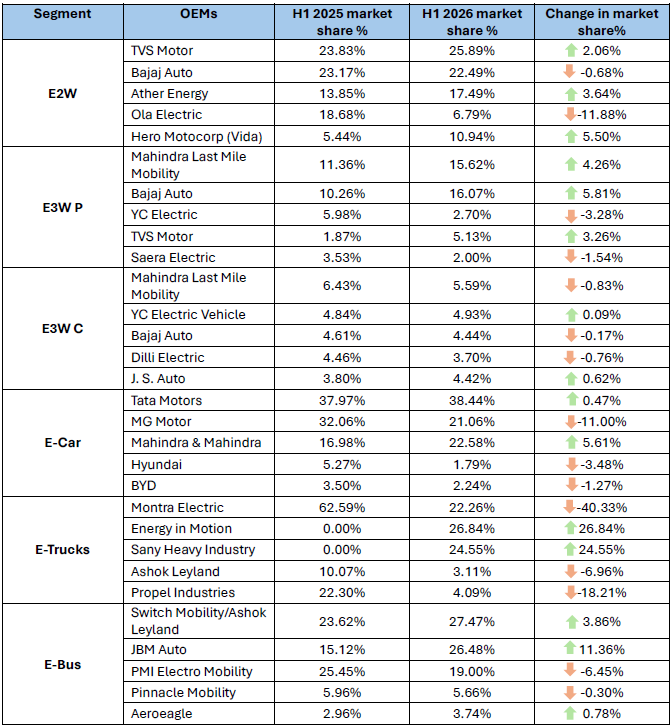
Table 1: Player wise market share % for each segment in EV – H1 2025 VS H1 2026
Source: JMK Research, Vahan Dashboard
E2W: In H1 2025, TVS Motor retained its leadership, increasing its market share to 25.89%, while Ather Energy and Hero MotoCorp recorded notable gains, supported by strong brand equity, dependable products, and well-established sales and service networks. In contrast, Ola Electric’s market share declined sharply from 18.68% in H1 2025 to 6.79% in H1 2026, primarily due to service-related concerns and intensifying competition. Looking ahead, the entry of additional legacy players such as Suzuki and Yamaha, along with new product launches, is expected to further intensify competition in the E2W market.
E3W (Passenger & Cargo): In the passenger segment, established OEMs strengthened their market position, with Bajaj Auto’s market share increasing from 10.26% to 16.07%, Mahindra Last Mile Mobility’s from 11.36% to 15.62%, and TVS Motor’s from 1.87% to 5.13%.In contrast, L3 category focused players such as YC Electric and Saera Electric saw their shares decline to 2.70% and 2.00%, respectively, indicating a gradual shift towards established brands. In the cargo segment, Mahindra Last Mile Mobility retained its leadership, while the overall competitive landscape remained relatively stable, with J.S. Auto improving its market position and other key players maintaining largely steady market shares, indicating a more fragmented market structure.
E-Car: The E-Car market in H1 2026 continued to be led by Tata Motors and Mahindra, supported by a strong portfolio of mass-market and premium electric SUVs. Tata Motors retained its leadership on the back of sustained demand for the Nexon EV while Mahindra strengthened its position through the successful launch of its new electric SUV lineup. Meanwhile MG Motor’s market share declined to 21.06%, amid intensifying competition.
E- Bus: The E-Bus market witnessed a notable shift in competitive dynamics during H1 2026, with Switch Mobility/Ashok Leyland emerging as the market leader with a 27.47% share, closely followed by JBM Auto, which significantly expanded its market share from 15.12% to 26.48%. In contrast, PMI Electro Mobility’s share declined from 25.45% to 19.00%, reflecting intensifying competition among leading OEMs. The market continued to consolidate around a few established players, supported by the execution of large government E-Bus procurement and deployment programs.
E-Trucks: The E-Trucks market remained at an early stage of development in H1 2026, with the competitive landscape evolving rapidly as new OEMs entered the segment. While Montra Electric’s market share declined from 62.59% in H1 2025 to 22.26% in H1 2026, new entrants such as Energy in Motion and SANY Heavy Industries captured significant market shares, reflecting increasing competition.
H2 2026 market outlook
India’s EV market is expected to maintain its growth momentum in H2 2026, supported by continued policy implementation, expanding charging infrastructure, and a broader product pipeline. The recently notified Delhi EV Policy 2026 earmarks INR 15,000 crore for EV adoption and Bihar’s amendments in its EV Policy aims to achieve 30% EV penetration in new vehicle registrations by 2030. Together, these initiatives are expected to strengthen the enabling ecosystem for EV adoption.
Across vehicle segments, new product launches and accelerating commercial deployments are expected to remain the key growth drivers in H2 2026. In the passenger vehicle segment, the recently launched Tata Tiago EV, priced INR 1 Lakh lower than previous model, would further accelerate the mass market adoption, while Tata Sierra EV will expand consumer choice in the SUV segment. Meanwhile new electric two-wheeler launches from OEMs such as TVS, Ampere, and Yamaha will further intensify competition. In the commercial vehicle segment, over 4,200 E-Buses were allocated combined under the PM E-Bus Sewa & PM E-drive in June 2026, coinciding with the highest-ever monthly E-bus sales of 710 units, indicating strong deployment momentum. Meanwhile, growing fleet electrification and an expanding portfolio of electric trucks are expected to support continued growth in the e-truck segment.