
India’s E-Car Sales Surpass FY2026 Volumes in Just Seven Months of FY2027
India’s electric passenger car market witnessed a significant acceleration, with sales in the first seven months of FY2027 (April–October 2026) surpassing the entire annual sales recorded in FY2026. The segment registered 2,19,145 electric cars during FY2027 (till Oct-2026), compared with 2,08,157 units in FY2026, representing a 5% increase over the previous financial year’s total in just seven months. It also witnessed a significant increase in EV penetration among overall car sales, rising from approximately 0.66% share of overall cars in FY2022 to 4.4% share in FY2026, and has already surpassed the 7.37% mark in FY2027 (till October 2026).
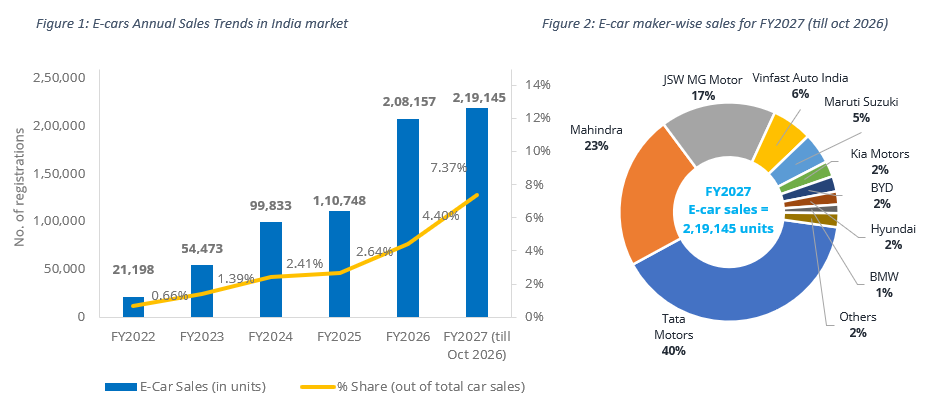
Source: Vahan Dashboard, JMK Research
The momentum was already visible in the first half of FY2027, when electric car sales reached 1,82,322 units, equivalent to 87.5 % of FY2026’s annual sales. The addition of 36,823 units in October further pushed cumulative sales beyond the previous year’s benchmark. This marks an important milestone for India’s electric passenger car market, reflecting an expanding customer base, a wider range of electric vehicle offerings and its growing acceptance across diverse vehicle categories and price points. One of the major factors supporting the acceleration in electric car sales is:
- Expanding range of products available to Indian consumers. During H1 FY2027, 13 electric car models were launched by manufacturers including Tata Motors, MG Motor, Kia, Mahindra and BMW. New entrants in the e-car segment such as Maruti Suzuki and Vinfast-Auto are also establishing their market presence with around 5% and 6% market share in FY2027 (till October 2026).
- Another notable development is the growing adoption of Battery-as-a-Service (BaaS) model. Six of the 13 models launched during H1 FY2027 offered BaaS options, allowing customers to purchase the vehicle at a lower upfront price by separating the battery cost from the vehicle purchase price. This model could improve affordability and reduce the initial financial barrier to electric car ownership.
The growing product portfolio is catering to diverse consumer requirements across affordability, driving range, vehicle size and performance, while intensifying competition among established automakers and new entrants. The segment is expected to sustain its growth momentum, supported by new model launches, OEM expansion, fleet electrification and improving affordability, despite persistent adoption barriers. Consequently, India’s electric car market could achieve approximately 25% EV penetration by FY2030, subject to the pace of market adoption and the resolution towards existing barriers.