
Powering India’s Secondary Steel Transition: The Business Case for Cluster Based Renewable Electricity Procurement
Cluster deep-dives: Raipur and Rajkot
For India’s secondary steel sector, the electric arc and induction furnace units that account for close to 38-40 per cent of the country’s crude steel and emit an estimated 50 to 60 million tonnes of carbon dioxide equivalent each year, renewable electricity is a rare lever that lowers cost and emissions at once. Electricity makes up as much as 40 per cent of these units’ operating cost, and renewable power now costs ₹4.5 to ₹6 per unit in several states against grid tariffs of ₹7 to ₹8, without any change to the furnace or the production route. Even so, renewable adoption in the sector remains around 11 per cent, roughly half its share in India’s overall generation mix. The constraint is no longer the technology or the tariff, but the institutional and regulatory mechanisms that decide whether a small unit can finance, structure and connect a project.
This report builds the business case for renewable procurement in India’s secondary steel clusters and sets out how it can be scaled. It pairs a national screening of clusters with detailed, on-ground assessment of two representative hubs and a comparative financial evaluation of the procurement routes open to a micro, small or medium enterprise.
The analysis begins with a Renewable Energy Attractiveness Index that ranks India’s secondary steel clusters on state policy, cost-saving potential, electricity consumption, market maturity and land availability. Raipur, Belgaum, Shimoga, Rajkot and Bhavnagar emerge as the five clusters best placed for renewable adoption.
From these, the study examines two contrasting clusters in depth. Raipur in Chhattisgarh is an integrated ecosystem of induction furnaces and rolling mills, while Rajkot in Gujarat is a scrap-based cluster of foundries and forging. Drawing on field visits and stakeholder consultations, the report profiles each cluster’s grid tariff structure, open access charges and the practical barriers that shape renewable uptake on the ground.
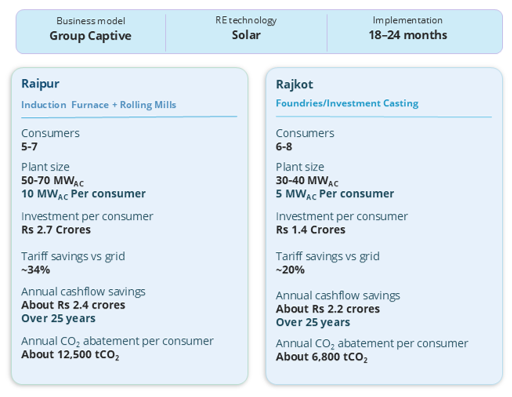
For each cluster, three procurement routes, Full Capex, Group Captive and Third-party Open Access, are modelled over a 25-year project life, measuring cashflow savings, landed tariffs, payback periods and emissions abatement. The results are drawn together into an indicative, cluster-level pilot that units can aggregate around and replicate across other clusters.
Figure 1: Indicative pilot project specifications for Raipur and Rajkot
Beyond the cluster economics, the report sets out the policy and financing measures needed to turn this opportunity into scale, reviews emerging pathways such as inter-state green open access, green hydrogen and energy storage, and outlines a way forward for cluster-based deployment.
This report was prepared by JMK Research and Analytics in collaboration with WWF-India, Climate Catalyst and CII-Green Business Centre, under a project supported by the India Green Steel Network.
Table of Contents
- How the Indian secondary steel sector is structured
- Geographic concentration of secondary steel clusters
- Renewable electricity as a critical lever for secondary steel decarbonisation
- Preliminary analysis of secondary steel clusters
- Detailed cluster analysis
- Raipur steel cluster
- Cluster overview
- Grid tariff profile
- Open access charges profile
- On-ground challenges
- Renewable energy procurement analysis
- Rajkot steel cluster
- Cluster overview
- Grid tariff profile
- Open access charges profile
- On-ground challenges
- Renewable energy procurement analysis
- Raipur steel cluster
- Recommendations
- Emerging decarbonization pathways
- Inter-state transmission system
- Green hydrogen
- Energy storage systems (ESS) and Round the Clock (RTC) power
- Way forward for cluster-based renewable energy deployment
- Conclusion
Enter email to download the full report: