

Advancing residential rooftop solar adoption in India under PM Surya Ghar Yojana
Date of release: October 2025
Report by JMK Research and IEEFA
The Government of India’s initiative to convert rooftops across the country into a significant solar energy resource marks a strategic move towards long-term energy security and self-reliance. Although initial progress in the residential rooftop solar (RTS) segment was limited, the sector witnessed a considerable shift following the introduction of the Pradhan Mantri Surya Ghar Yojana (PMSGY) last year.
The government launched PMSGY to make rooftop solar more accessible for households by reducing upfront costs and strengthening decentralised clean energy adoption across India. Before its launch, rooftop solar adoption remained concentrated in the commercial and industrial segments, while the residential sector lagged due to high upfront costs and limited awareness. PMSGY targeted this gap by offering capital incentives and simplified procedures to make rooftop solar financially attractive for households and to promote self-sustained, clean energy use at the household level.
As of July 2025, PMSGY has witnessed significant traction, with over 57.9 lakh applications for residential rooftop solar installations. The scheme has facilitated the installation of 4,946 MW of rooftop solar capacity till July 2025 across various states and Union territories, indicating robust on-ground execution. Subsidy disbursements have crossed INR 9,281 crore (USD 1.05 billion) benefiting over 16 lakh households, reflecting strong financial support and household-level participation. These figures underscore growing public interest in solar adoption and the effectiveness of central incentives in accelerating clean energy uptake.
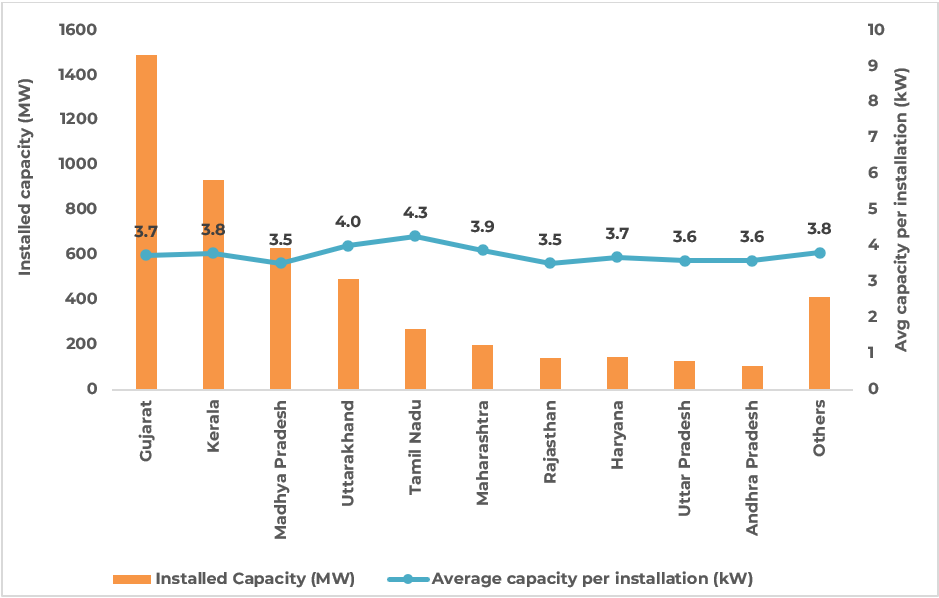
Figure 1: Installed capacity by state & UT under PMSGY (as of July 2025)
Source: PMSGY National Portal, JMK Research
Under the PM Surya Ghar: Muft Bijli Yojana, Gujarat leads all states with the highest installed residential rooftop solar capacity of 1,491MW, followed by Maharashtra, Uttar Pradesh, Kerala, and Rajasthan. These states in the top five together account for approximately 77.2% of the total installed capacity (4,946 MW) under the scheme till July 2025. This concentration reflects stronger policy push, awareness, and adoption in these states compared to others.
To accelerate residential rooftop solar (RTS) deployment, several Indian states have implemented financial incentives that either supplement the central subsidy or independently support consumers. States like Assam, Delhi, Goa, Uttar Pradesh, and Uttarakhand have introduced direct capital subsidies to offset high upfront installation costs. Some states also promote RTS through tax and duty exemptions.
However, despite a near fourfold increase in applications between March 2024 and July 2025, only 13.1% of the target 1 crore (10 million) installations had been completed, and just 14.1% of the allocated INR 65,700 crore (USD 7.5 billion) in subsidies released till July 2025. In this scenario, the FY2027 target continues to be viewed as a considerable challenge.
To unlock its full potential, PMSGY must address challenges around subsidy disbursements, digital processes, consumer awareness, and domestic supply chain readiness. Streamlining approvals, upgrading digital platforms, and building stronger awareness campaigns will be essential to ensure smoother conversion of applications into installations. At the same time, domestic content requirements should evolve into an opportunity for scaling up local manufacturing while minimising supply-side bottlenecks. If these measures are prioritised, the scheme can create a more predictable investment environment and establish India as a competitive hub for rooftop solar solutions.
Looking forward, the long-term success of PMSGY will hinge not only on the provision of subsidies but also on its ability to institutionalise streamlined digital processes, standardised product solutions, and consumer-centric support systems. If these gaps are addressed, the scheme could transition from being subsidy-driven to a sustainable, market-trusted programme. In doing so, PMSGY has the potential to transform India’s residential rooftop segment into a scalable and inclusive pillar of the country’s clean energy transition.
Table of Contents
- Introduction
- Current status
- State-wise RTS installed capacity under PMSGY
- Number of applications vs installations
- State attractiveness for residential rooftop solar
- Policy development
- Additional capital incentives across states for residential segment
- Key stakeholders under PMSGY
- Original equipment manufacturers (OEMs)
- Financiers
- Vendors
- Challenges of PMSGY
- Consumer-side barriers
- DCR-related issues
- Technical and logistical hurdles
- Recommendations
- Policy and regulatory reforms
- PMSGY procedural reforms
- Others
- Conclusion
Enter email to download the report