
Mandatory Registration of all Electric Rickshaws across States in India
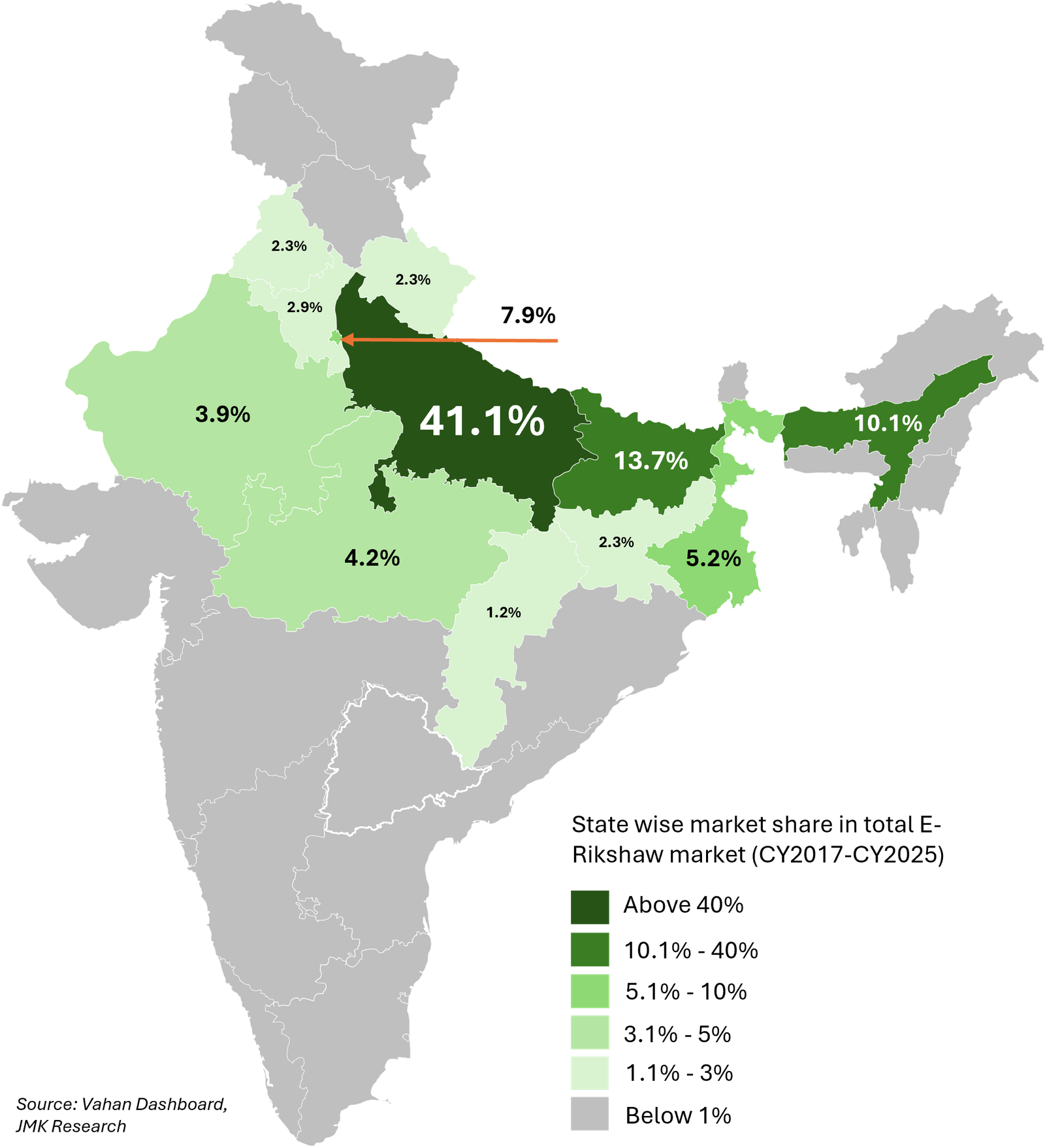
India’s electric three-wheeler (e3W) segment has emerged as a major contributor to EV adoption, accounting for around 28.73% of total EV registrations across all vehicle categories between CY2017 and CY2025. Despite this scale, reported sales figures do not always reflect real market behaviour on the ground. Adoption of electric rickshaws is also highly uneven across the country and concentrated in a few key states. Between CY2017-CY2025, Uttar Pradesh alone accounted for 41.1% of cumulative e-rickshaw registrations, followed by Bihar (13.7%), Assam (10.1%), Delhi (7.9%), and West Bengal (5.2%), highlighting the strong regional concentration in India’s e-rickshaw market.
Figure 1: State-wise market share in total E-Rikshaw market in India (CY2017-CY2025)
An Unusual Spike in West Bengal’s E Rikshaw data:
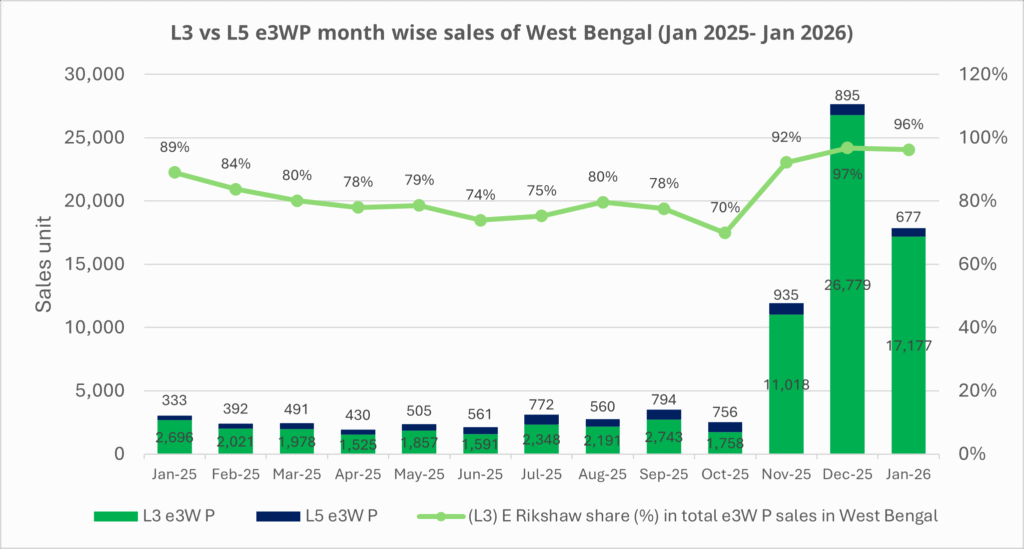
In October 2025, the West Bengal Transport Department announced mandatory registration of all electric rickshaws (commonly known as ToTo in the state). The deadline for enrolment was initially set for December 31, 2025, and later extended to January 31, 2026 to allow more operators to comply. This enforcement drive led to bulk registration of previously unregistered e-rickshaws, which got reflected in VAHAN during November 2025–January 2026.
Figure 2: L3 vs L5 e3W Passenger month wise sales of West Bengal (Jan 2025- Jan 2026)
Source: Vahan dashboard and JMK research
A category-wise breakdown of West Bengal’s passenger e3W registrations further clarifies where the post-enforcement increase has occurred. Throughout the year,
- L3 electric rickshaws typically account for an average 80% of monthly passenger e3W registrations for most of the year.
- Following the registration drive, the L3 share rises sharply to nearly 96–97% of total passenger e3W sales in December 2025 and January 2026.
Policy Enforcement against Unregistered E-Rikshaws:
A broader national context had already emerged earlier in mid-2025, where the Electric Vehicle Manufacturers Society (EVMS) estimated that approximately 4.75 lakh electric rickshaws were operating illegally across India, without registration, fitness certification, or insurance. This highlighted that a significant portion of India’s electric three-wheeler passenger fleet was missing from official data, creating both safety risks and major underreporting of EV adoption.
Regulation in Other States:
Looking beyond West Bengal, there are early indications that other states are also beginning to tighten oversight of unregistered electric rickshaws. In NCR, the Delhi government is considering a one-month registration window for unregistered e-rickshaw operators, while the Delhi High Court has taken up a public interest case seeking stricter enforcement of e-rickshaw regulations. This reflects growing administrative and legal focus on bringing these vehicles into the formal system, particularly in regions where e-rickshaw usage is already high.
These developments suggest that the issue of unregistered e-rickshaws, and the resulting data gap in India’s EV statistics, is not limited to a single state. If large e-rickshaw markets such as Uttar Pradesh and Bihar implement registration drives similar to West Bengal, India’s reported EV numbers could rise materially, not due to new demand, but because a substantial informal fleet is finally being captured in official data. Over time, this would provide a more accurate picture of EV penetration, particularly for passenger electric three-wheelers and strengthen the quality of data used for policy formulation and market planning.